


Want to make probiotic-rich drinks without the hassle of ordering special starter cultures? Well then, this ginger bug recipe is for you. With just three simple ingredients – fresh ginger, sugar, and water – you can create the base for:
- Fizzy Ginger Ale (click here for the recipe)
- Root beer (recipe coming soon)
- Homemade soda made with sweetened herbal tea (recipe below)
- Homemade soda made with fruit juice (recipe below)
So, what is a ginger bug?
The brown, papery skin of fresh ginger root naturally attracts wild yeast and beneficial bacteria. When you mix the root with water and a food source for the yeast and bacteria, you get a bubbly, probiotic-rich starter culture – aka a collection of beneficial microorganisms that orchestrate the fermentation process.
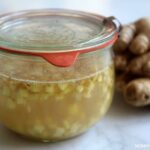
Since it’s a living culture, we named ours like a pet – pictured above is Yeasty Beasty. 🙂
Anyway, as the good guys eat the food (sugar) they emit carbon dioxide, which is what creates the bubbles. To make a version of homemade soda, some people like to mix their ginger bug with a sweetened liquid and then ferment them in flip top bottles for a few days to increase carbonation. You’ll find some recipe suggestions for doing that at the bottom of this article.
3 Tips For Fermenting Success
Use Organic Ginger – Some conventional types of ginger are irradiated during the import process or to prevent sprouting. Irradiation kills the beneficial yeasts and bacteria needed to kickstart the fermentation process.
Use Non-Chlorinated Water – Chlorine kills the good guys, too.
Don’t Use Honey – It has its own microbial ecology that will compete with the beneficial yeast and bacteria on the ginger. Instead, I use organic white sugar (which I keep on hand to make homemade sugar scrub) or an unrefined sugar like rapadura. Although it will be sweet, much of the sugar will be used up during the fermentation process and will not be in the final product.

Ginger Bug Recipe
Want to make fizzy ginger ale, root beer and other probiotic-rich drinks? Well then, this ginger bug recipe is for you. Prep Time 5 minutes Author Heather Dessinger
- weck tulip jar or mason jar with lid
- measuring teaspoon
- measuring tablespoon
- strainer
- sharp knife
- measuring cup
- 1¾ cup filtered water
- 2 tsp unpeeled, organic fresh ginger
- 2 tsp sugar (Organic white sugar or unrefined sugar will both work)
- More sugar and ginger to feed the bug (2 tsp of each daily)
- Place room temperature water, sugar and diced ginger in a clean jar. (I use a 16 ounce weck tulip jar or mason jar.)
- Firmly attach a lid to the jar, give it a good shake, and set it in a warm spot (72-80°F) for 24 hours.
- The next day, feed the ginger bug by adding 2 tsp chopped ginger, 2 tsp sugar, and shaking it again. Repeat this step for 3-5 more days. The ginger bug is ready to use when you see little bubbles forming.
Using Your Ginger Bug
- When your ginger bug is ready, strain out the liquid you need to use as a starter for your ginger ale, root beer, etc.
Resting or Reusing Your Ginger Bug
- Now that you've harvested your first batch of starter from your ginger bug, you have two options:
- Keep feeding it daily so that you can start a new batch soon – OR – let your ginger bug "sleep" by placing it in the fridge. It will only need to be fed once a week and can be reactivated whenever you'd like.
- To keep feeding it so that you can reuse it as soon as possible: If you removed ½ cup starter (or whatever amount), replace it the same amount of non-chlorinated water. Continue feeding the ginger bug 2 tsp of chopped ginger and 2 tsp of sugar. It's ready to use when it starts bubbling again.
- To let your ginger bug "sleep": Place your ginger bug in the fridge. Once a week set it on the counter and add 1 tablespoon chopped ginger and 1 tablespoon sugar. Allow it to reach room temperature for a few hours (or longer) and then tuck it back in the fridge. When you're ready to use it, replace the volume that you last removed (for example, ½ cup) with water and start feeding it 2 tsp ginger root and 2 tsp sugar daily.


Ginger Bug Soda Recipes
Ginger Ale – Click here for the recipe.
Root Beer – Recipe coming soon.
Herbal Sweetened Tea – Brew 8 cups of water with any flavor herbal tea you like and 3/4 cup sugar. Once it’s cooled to room temperature, pour in 1/2 cup ginger bug and mix thoroughly. Pour into flip-top bottles (leaving one inch of head space) and ferment for 3-6 days. * See note below.
Fruit Juice Soda – Mix 8 cups juice with 1/2 cup ginger bug starter. Pour into flip-top bottles (leaving one inch of head space) and ferment for 3-6 days. * See note below.
* Note: Be sure to “burp” the bottles by opening them every 1-2 days so the carbonation doesn’t build up too much. Some people have reported that their bottles exploded because they let them ferment for way too long without burping them. I’ve been making fermented drinks for years and have never had that happen, but I have forgotten about them for a few days and ended up with an extra fizzy bottle that poured out like champagne. I open my bottles on our deck now just in case. 🙂
More Probiotic-Rich Recipes
Coconut Yogurt – You probably have everything you need to make this creamy, thick yogurt right now. Unlike some methods, you don’t need a thermometer or a lot of hands-on time. It’s super easy, delicious, dairy-free, and way more affordable than store-bought.
Beet Kvass Recipe – I don’t love beets in general, but this tangy kvass is an exception. You don’t need a starter, and it can be flavored with ginger, citrus peels, bits of fresh pineapple, or whatever sounds good to you.
Water Kefir – This is another type of fizzy soda that doesn’t have a gingery flavor.
Frequently Asked Questions
My ginger bug is not bubbling. Why?
One possibility is that the area you are fermenting in is simply not warm enough. Yeasty Beasty wasn’t really doing much after five days when I started him recently, so I covered him with a towel (to protect him from direct light) and put him on our warm back deck. He was thriving in a couple of days.
Another possibility is that the ginger root was irradiated or rinsed in something that killed the beneficial yeast and bacteria. That should not be the case with organic ginger, but it may happen from time to time. If placing it in a warmer spot (as mentioned above) doesn’t work, I’d assume it is the ginger and start with a fresh piece.
Many tutorials say to cover the ginger bug with cheesecloth or a coffee filter secured by a rubber band, but you use a lid. Why?
Some ferments do better in an aerobic (oxygen-rich) environment – kombucha is one example – while others do better in an anaerobic (low-oxygen) environment. In my experience, ginger bugs do better in the latter.

